Modernizing Private Golf Clubs Without Losing Their Soul.
Strategic brand architecture and governance-aligned modernization for member-owned clubs in transition.
Private Clubs Are Navigating a Structural Inflection Point.
Demographics are shifting. Expectations are evolving. Digital infrastructure often lags cultural reality. Governance complexity increases as boards rotate and leadership transitions.
Modernization is necessary.
Poorly executed modernization erodes identity.
The challenge is not marketing.
The challenge is disciplined institutional evolution.
Private clubs increasingly encounter:
Aging membership demographics
Brand stagnation and diluted positioning
Governance friction between boards and management
Inconsistent member communication systems
Underutilized digital infrastructure
Attracting the next generation without destabilizing the current one
Modernization must reinforce institutional culture, not replace it.
Private Club Brand Architecture.
Modernization without structure creates instability.
Structure without modernization creates stagnation.
Private Club Brand Architecture aligns governance, communication, culture, and digital infrastructure into a disciplined modernization framework.
This approach is not marketing.
It is architectural.
It begins with strategic positioning rooted in institutional identity.
It integrates governance-aligned communication systems that respect board rotation and leadership cadence.
It establishes member engagement infrastructure that reinforces culture rather than chasing trends.
It modernizes digital systems without introducing cultural disruption.
Modernization must operate within the rhythms of governance, member psychology, and long-term stewardship.
When modernization is layered carefully into institutional structure, clubs evolve without losing cohesion.
Architecture replaces fragmentation with coherence.
Modernization must be engineered, not improvised.
Case Study
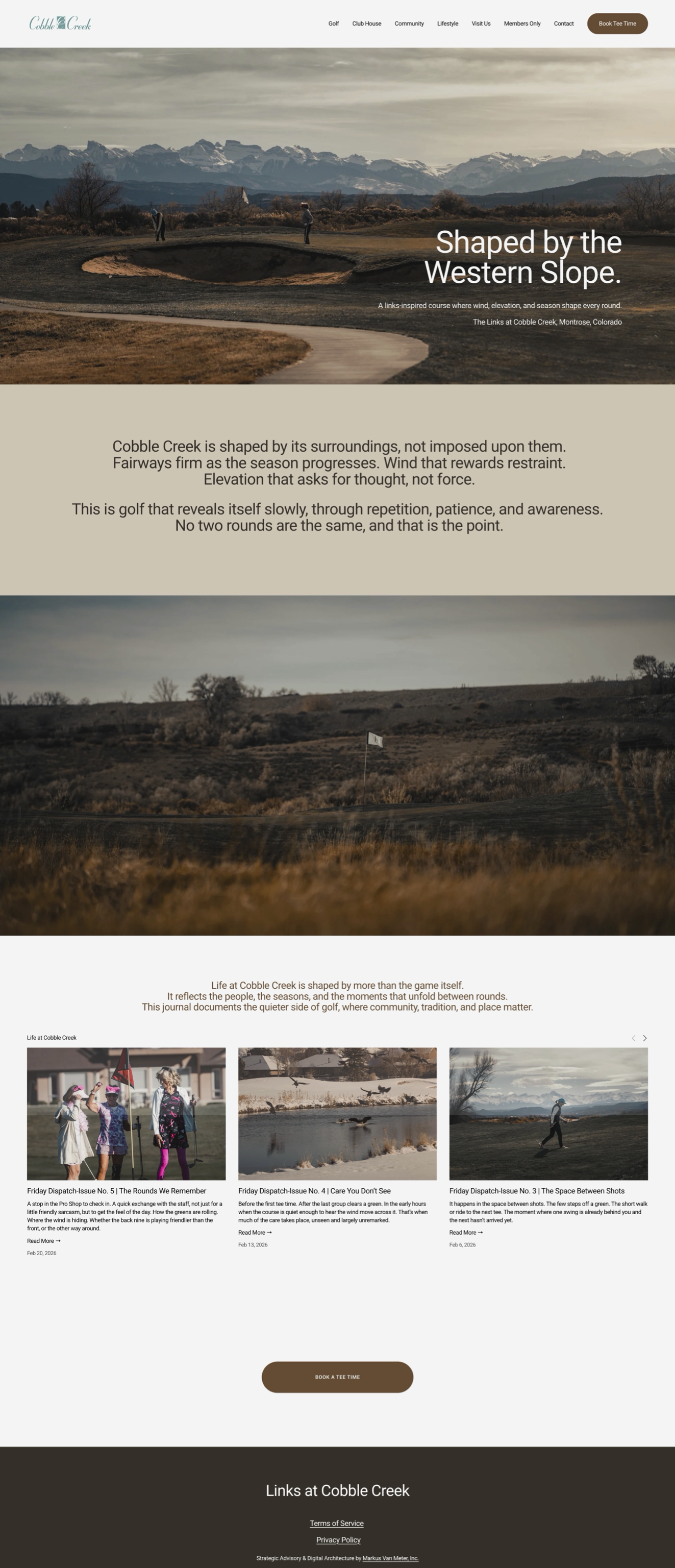
Links at Cobble Creek
A member-owned private club navigating governance complexity, brand drift, and digital fragmentation.
Situation
Cobble Creek operates within a member-owned governance structure, balancing public access with institutional identity.
Like many governance-driven clubs, it faced structural friction:
Brand positioning lacked clarity
Digital infrastructure was underdeveloped
Governance communication was inconsistent
Member engagement systems were fragmented
Modernization was necessary.
Cultural cohesion could not be compromised.
Intervention
A disciplined architectural framework was implemented:
Institutional repositioning anchored in identity
Governance-aligned website reconstruction
Structured weekly member communication system
Board-level messaging alignment
Digital infrastructure modernization
Modernization was integrated deliberately, not introduced disruptively.
Architecture Built
Institutional website platform
Governance-aware communication cadence
Structured newsletter infrastructure
Cultural reinforcement through narrative discipline
Long-horizon modernization roadmap
Outcome
Improved board cohesion
Elevated institutional perception
Stabilized communication rhythm
Infrastructure prepared for continued evolution
Institutional modernization requires discipline, not disruption.
Engagement
Select long-term partnerships with governance-driven clubs committed to disciplined modernization.
Markus works with a limited number of clubs annually through structured retainer engagements.
These partnerships provide ongoing strategic oversight, governance-aligned advisory, communication architecture development, and digital systems integration.
The objective is continuity.
Modernization requires rhythm, board awareness, and long-horizon planning. It cannot be executed effectively through isolated campaigns or short-term initiatives.
Engagements are structured to operate alongside existing leadership, reinforcing institutional stability while guiding modernization deliberately over time.
Select partnerships are considered following an initial strategic conversation.